
The Visible Unknown
This is an ongoing project. New images will be added as the work continues to evolve.
The Visible Unknown is a photographic project exploring moments when perception loosens and the familiar world begins to feel subtly displaced, as if lived experience has shifted closer to simulation than certainty. The work is shaped by my lived experience of keratoconus, a degenerative eye condition that alters brightness and form, and derealisation disorder, a mental health condition that can produce a sense of distance between self and environment. These conditions do not define the images, but they inform how I understand clarity, steadiness and the fragile thresholds between inner and outer life.
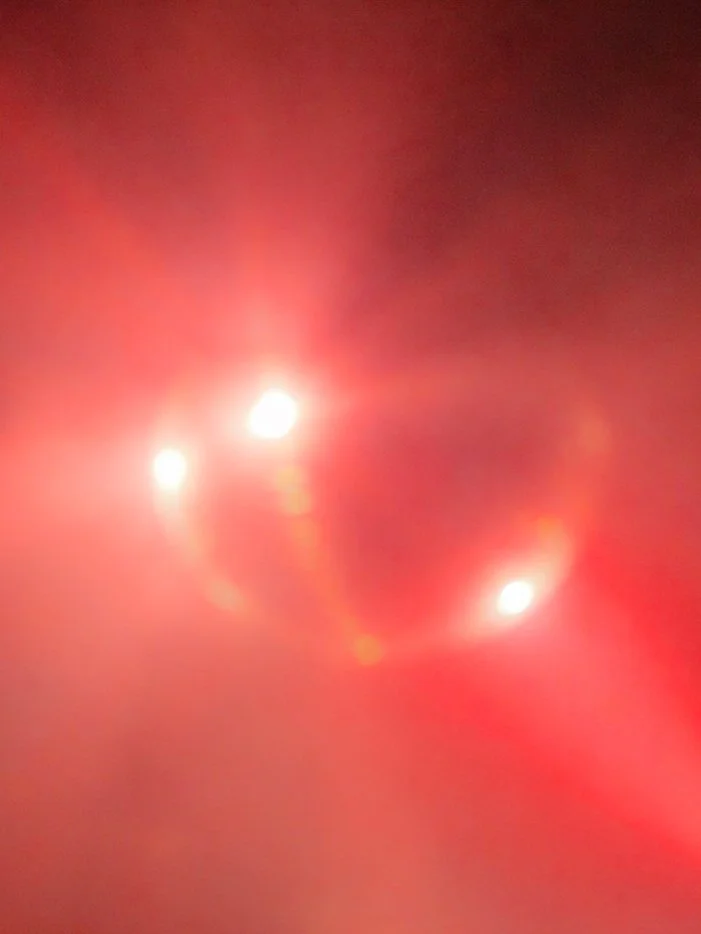
Rather than attempting to reproduce how I see, the photographs move beyond literal vision into a more emotional and sensory territory. The images are made deliberately out of focus using in camera methods that push clarity beyond recognition. This softness is not an aesthetic effect but a conceptual tool. By removing the anchor of detail, the work asks what kind of truth remains when vision becomes a felt experience rather than a descriptive one.
Across the wider project the images move through a number of thematic states including belief and symbolism, everyday performance, emotional states, landscape and place, and mediation and simulation. Each photograph sits within more than one of these territories, allowing meaning to emerge gradually through atmosphere rather than explanation.
A central aim of the project is to bring a lesser discussed mental health experience into view without spectacle or simplification. Derealisation can be difficult to articulate, both medically and emotionally. In The Visible Unknown it is approached through mood, absence and perceptual distance, creating space for viewers to recognise their own moments of disconnection, vulnerability or quiet estrangement.
At its core the project is about attention. About slowing down enough to notice how the familiar can begin to feel staged, and how everyday life can take on a subtly unreal quality. The images do not attempt to resolve these states. Instead they hold space for reflection on perception, mental health and the fragile ways we orient ourselves within the world.
-
Although keratoconus informs the origins of this project, the photographs do not attempt to mimic my eyesight. My everyday vision contains distortion and shifting clarity, but it remains anchored in a recognisable world. The images in The Visible Unknown push beyond that threshold.
The extreme blur functions as a conceptual tool rather than a clinical representation. By exceeding what the eye can normally resolve, the work explores the emotional and sensory dimensions of seeing without the stabilising anchor of detail. In this way the project becomes less about sight itself and more about perception, vulnerability and the uncertain territory between knowing and sensing.