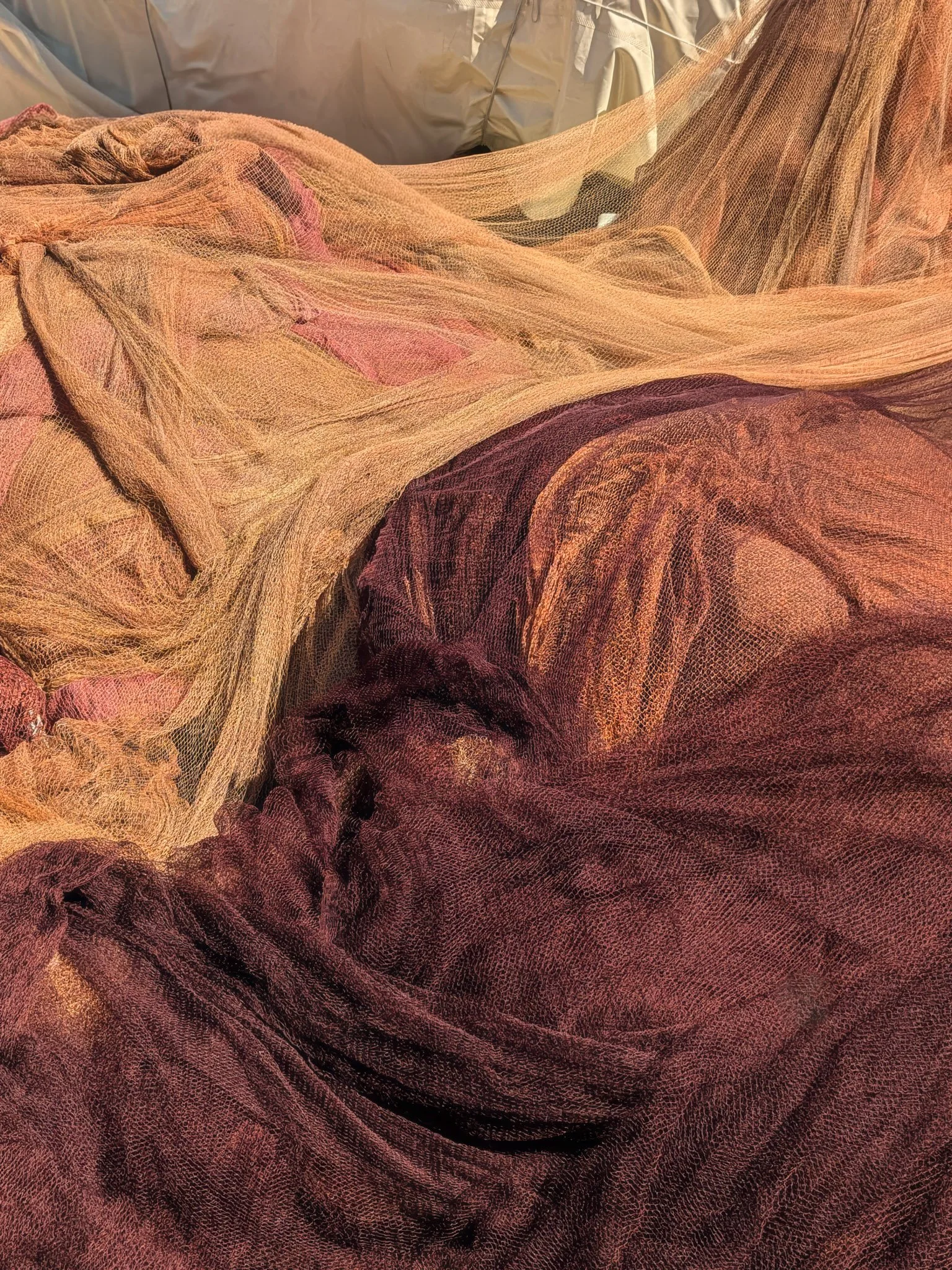
I PHOTOGRAPH THE WORLD AT THE EDGE OF RECOGNITION, WHERE THE EVERYDAY SLIPS INTO SOMETHING QUIETER AND MORE SURREAL.
SHORT BIO
Robby Ogilvie (b. 1986, Edinburgh) is a Scottish photographic artist exploring perception, place and our relationship with the environments we inhabit. Working across digital, analogue and mobile photography, his practice moves between conceptual and post documentary approaches, focusing on moments when familiar environments begin to shift through attention, colour, light, structure and changes in perception.
He holds an MA in Contemporary Art Theory with Distinction from Edinburgh College of Art. His background in art theory and design continues to inform an interest in how images are constructed, sequenced and experienced.
Ogilvie is the winner of the Object category in the 2026 Sony World Photography Awards Open Competition for Colour Divides, and a Global Award Winner of RED, the international i-D × Ray-Ban art award. Recent recognition also includes the International Photography Awards, Architecture Photography Awards, National Geographic Traveller Photography Competition, Benjamin Hall Photography Award and Minimalist Photography Awards.
His work has been exhibited internationally at Somerset House, London; the Royal Scottish Academy, Edinburgh; Tokyo Photographic Art Museum; Museo Diocesano Carlo Maria Martini, Milan; Les Rencontres d’Arles; Art Basel Hong Kong; and TAPANCO Gallery, Mexico. In September 2026 he will present work at Saatchi Gallery, London, as part of Digitalism at the British Art Fair.
His work and practice have been published and featured internationally, including by The Guardian, the World Photography Organisation, SOFT Publishing, NOICE, BROAD and Ephemere.
Ogilvie is also an active self publisher of photographic artist books and zines, including Intervals: Volume One, COURTS and the ongoing Spirit of Place series. He lives and works in Edinburgh, Scotland.
ARTIST STATEMENT
I photograph the world at the edge of recognition, where the everyday slips into something quieter and more surreal.
My practice explores perception, place and our relationship with the environments we inhabit. Working between conceptual and post documentary photography, I begin with encounters in the world as I find it, but use photography less as a means of description than as a way of questioning how we see, interpret and assign meaning to what surrounds us.
Attention is central to this process. I am drawn to ordinary spaces, objects and situations that might otherwise be passed over: an empty structure temporarily released from its function, light altering a familiar surface, an unexpected relationship between colour and form, or a moment when recognition becomes unstable. Through framing, sequencing, defocus, repetition or simply remaining with a subject, I am interested in how small shifts in attention can change the way an environment is experienced.
My working process moves between sustained observation and instinctive responsiveness. Some photographs emerge through repeated encounters with the same places, while others depend on recognising a fleeting alignment that cannot be reconstructed. Across both approaches, I am interested in the threshold at which the familiar begins to operate differently: when a functional space moves towards abstraction, an overlooked object becomes charged with presence, or visual certainty gives way to projection and feeling.
I work across digital, analogue and mobile formats, treating the choice of camera as part of the enquiry rather than a hierarchy of value. The immediacy of the mobile phone allows me to respond to everyday encounters while questioning assumptions around photographic legitimacy and authorship. Analogue processes introduce slowness, duration and uncertainty. Digital photography offers another form of responsiveness. Each changes not only how an image looks, but how I move through and attend to the world while making it.
My lived experience of keratoconus and derealisation has also shaped my understanding of perception as active, embodied and potentially unstable. These experiences do not define the practice or function as subjects to be illustrated, but they have heightened my awareness of the fragile relationship between seeing, recognition and certainty. This becomes most explicit in The Visible Unknown, while contributing more broadly to an interest in how reality can remain visually familiar yet be experienced differently.
Across individual projects, these concerns take different forms. I consider what becomes visible when activity recedes from a space, why some objects or images are deemed worthy of attention while others are overlooked, how the mind constructs connections between unrelated photographs, and what happens when photographic clarity can no longer be assumed to correspond with truth. Underlying these enquiries is a recurring question: how much of what we understand about the world belongs to what is physically present, and how much is produced through the act of looking?
Photography, for me, is therefore not a means of resolving the world but a way of remaining attentive to it. The images create small interruptions in habitual ways of seeing, asking the viewer to spend longer with what initially appears ordinary, partial or uncertain. At the centre of the practice is a belief that sustained attention can alter our relationship with the environments we inhabit, and that the familiar can always be encountered again.